6G technology in Europe could begin to move from research projects to initial commercial deployment around 2030. Unlike previous generations of mobile networks, however, 6G is not being developed only to offer faster downloads.
It is expected to combine communications, artificial intelligence, precise positioning and the ability to sense what is happening in the physical environment.
These capabilities could support safer transport, industrial automation, healthcare applications and smarter infrastructure.
At the same time, they raise a difficult question: what happens when a mobile network is no longer limited to transmitting information, but can also collect information about people and places?
Table of Contents
What is 6G?
6G is the name commonly used for the sixth generation of mobile communications and the planned successor to 5G.
The official international framework is called IMT-2030. In its recommendation outlining the framework and objectives of IMT-2030, the International Telecommunication Union identifies capabilities such as artificial intelligence integration, improved positioning, sensing, greater coverage, sustainability and interoperability.
This means that 6G is expected to become more than a faster mobile connection. The network itself could contribute to interpreting its surroundings and adjusting its operation according to real-world conditions.
According to the ITU’s current IMT-2030 development process, proposals for candidate radio technologies are expected between February 2027 and February 2029. Technical evaluation and international standardization must therefore continue before commercial networks can be launched.
When will 6G Technology arrive in Europe?
The European Commission says that 6G deployment in Europe could begin by 2030.
This does not mean that every European country will have extensive 6G coverage in 2030. The date should be understood as a target for the beginning of deployment, not as a deadline for complete coverage.
The European Union is supporting research through the Smart Networks and Services Joint Undertaking, a public-private initiative established to help Europe develop and shape 6G systems by 2030.
European authorities are also working on the frequencies that future networks may use. The European Commission’s 6G Spectrum Roadmap subgroup states that its work is intended to help initial mass-market deployment begin in 2030.
Before that happens, the technology must pass through several stages:
- research and experimental projects;
- development of international technical standards;
- allocation of radio spectrum;
- testing by equipment manufacturers and operators;
- national authorization and commercial investment.
For this reason, widespread coverage across Europe is more likely to develop gradually during the 2030s.
When could 6G arrive in Italy?
There is currently no confirmed date for the commercial launch of 6G in Italy.
Italy is expected to follow the broader European and international standardization process. An initial launch around 2030 may be technically possible, but the actual schedule will depend on spectrum decisions, network investment, equipment availability and the commercial plans of Italian telecommunications operators.
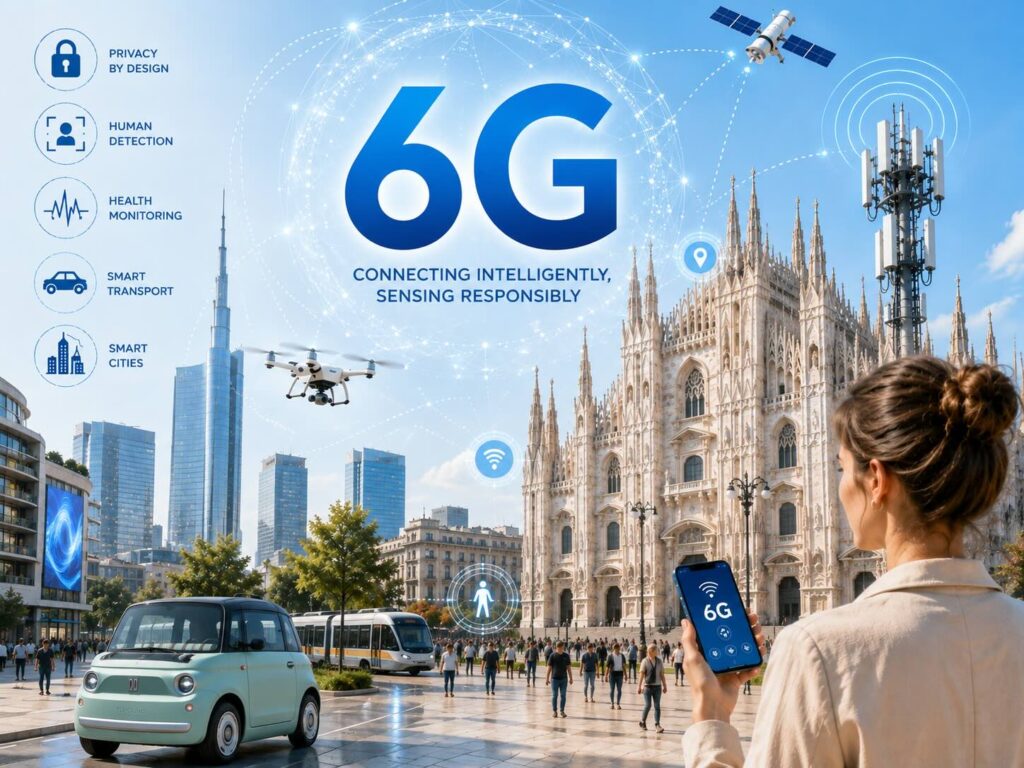
As happened with 5G, the first services would probably appear in selected urban or industrial areas before reaching smaller towns and rural regions. This is a reasonable expectation based on how mobile networks are normally introduced, but it is not yet an official Italian deployment plan.
In other words, people in Italy should not expect a sudden nationwide switch from 5G to 6G. The two technologies are likely to coexist for years while infrastructure is gradually upgraded.
What will make 6G different from 5G?
Speed will be part of the difference, but it may not be the most important one.
The ITU’s IMT-2030 framework includes new capabilities related to sensing, artificial intelligence, positioning, coverage and sustainability.
Possible characteristics of future 6G networks include:
- higher data capacity;
- extremely low latency;
- more precise indoor and outdoor positioning;
- AI-assisted network management;
- closer integration with satellite and non-terrestrial networks;
- improved support for connected vehicles and machines;
- communication and environmental sensing through the same infrastructure.
The final performance requirements and technical specifications are still being developed. For that reason, dramatic claims about exact speeds or guaranteed capabilities should be treated cautiously until the standards are completed.
Integrated Sensing and Communication: the defining feature of 6G
One of the most important concepts associated with 6G is Integrated Sensing and Communication, usually abbreviated as ISAC.
In conventional mobile networks, radio signals are mainly used to carry information between devices and network infrastructure. With ISAC, those same signals could also be analysed to gather information about the surrounding environment.
A major technical overview titled “The Integrated Sensing and Communication Revolution for 6G” explains how future wireless networks could combine communication signals, infrastructure sensors and information collected by connected devices.
The basic principle resembles radar. Radio waves travel through an environment and are reflected, absorbed or modified when they encounter walls, objects or people. By examining those changes, a system may be able to estimate what is present and how it is moving.
Potential uses include:
- detecting obstacles around vehicles;
- monitoring traffic flows;
- identifying hazards in factories;
- supporting robots and autonomous systems;
- mapping indoor spaces;
- detecting drones;
- monitoring buildings and infrastructure;
- creating real-time digital representations of physical environments.
These uses could reduce the need to install separate sensors for every application. The communications network itself could become part of the sensing infrastructure.
Could 6G detect people?
Potentially, yes.
Research into radio-frequency sensing has demonstrated that wireless signals can be used to identify human presence, movement and activity in certain conditions.
The capabilities discussed in research on human and environmental sensing through ISAC include the analysis of measurable changes produced by human motion and physiological activity in wireless signals.
Depending on the frequencies, antennas, software and position of the equipment, sensing systems may be able to estimate:
- whether a person is present;
- where someone is located;
- whether the person is moving;
- walking direction or speed;
- gestures or body movements;
- occupancy of a room;
- activity patterns.
However, these are not universal abilities that every future 6G antenna will necessarily have. Their accuracy will depend on the design of the network, the surrounding environment and the purpose for which sensing has been enabled.
Could 6G detect breathing or heart rate?
Radio-frequency systems have already been tested for contactless monitoring of very small body movements.
Breathing causes subtle, repeated movement of the chest. Under suitable conditions, radio signals can capture variations associated with that movement. Some experimental systems have also extracted information related to heart activity.
A 2026 paper on privacy challenges created by ISAC in 6G networks notes that advanced sensing could expose physiological information such as breathing frequency or data related to heart rate.
This does not mean that ordinary mobile towers will automatically read the vital signs of everyone nearby.
Such monitoring would depend on factors including:
- the frequency and bandwidth used;
- the distance between the person and the sensing equipment;
- antenna configuration;
- signal quality;
- environmental interference;
- the algorithms used to interpret the signal;
- whether the system was intentionally configured for physiological sensing.
It is therefore more accurate to say that 6G-related sensing could make this technically possible in some circumstances, rather than claiming that all future networks will routinely do it.
Why 6G creates new privacy risks
Previous privacy debates about mobile networks have focused mainly on information produced or transmitted by devices: location records, browsing activity, calls, messages and app data.
ISAC introduces a different problem. A person may become a source of information even without actively connecting a device to the network.
Radio waves can interact with people, objects and buildings. A sensing system may then infer information from those interactions.
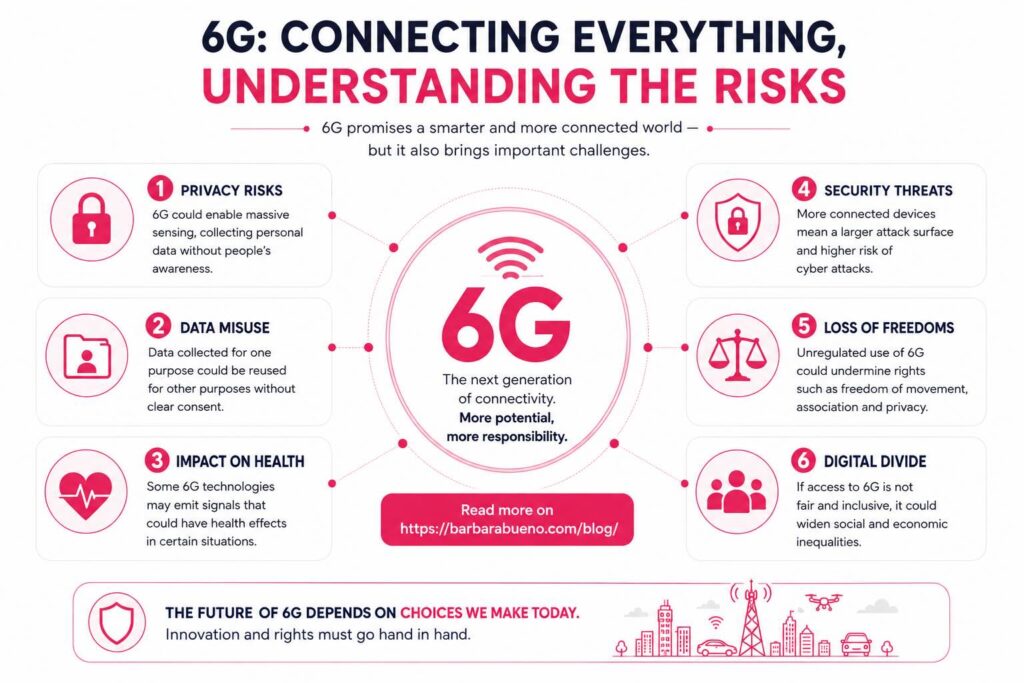
The authors of “ISAC Privacy: Challenges and Solutions for 6G” divide potentially sensitive sensing information into three broad categories:
- location and environmental data;
- behavioural information, such as movement or activity;
- physiological information, such as breathing patterns.
This creates questions that existing mobile privacy controls may not adequately answer.
How can someone refuse environmental sensing? How will a person know that it is taking place? Who owns information inferred from a body rather than transmitted by a personal device? Can bystanders be monitored even though they never agreed to use the service?
Germany’s data protection authorities have already raised concerns
The privacy implications are not being discussed only by researchers.
On 17 June 2026, Germany’s Conference of Independent Data Protection Authorities published a position paper on data protection in Integrated Sensing and Communication.
The document addresses ISAC standardization for Wi-Fi and sixth-generation mobile communications. Its timing is significant: regulators are attempting to influence the development of technical standards before the systems become widely available.
This approach follows the principle of privacy by design, under which privacy safeguards should be incorporated into a technology from the beginning instead of being added after deployment.
For Europe, future ISAC systems will also have to be considered in relation to the General Data Protection Regulation. Depending on what a system detects and how the information is processed, sensing data could reveal a person’s location, behaviour or physical condition.
Consent could become particularly difficult
Consent is relatively easy to imagine when someone installs an application or activates a service. Environmental sensing is more complicated because it may also affect people who have no direct relationship with the network operator or service provider.
Possible examples include:
- pedestrians passing through a monitored area;
- employees working near sensing equipment;
- residents inside buildings covered by wireless signals;
- customers entering a shop;
- passengers inside a vehicle or station;
- visitors who do not carry a connected device.
A system could potentially detect their presence or behaviour without requiring them to install an application or press an acceptance button.
This does not mean such processing will automatically be legal in Europe. It means that regulators and engineers will need mechanisms that provide a lawful basis, transparency, limits on use and protection for bystanders.
Could 6G see through walls?
The answer requires caution.
Some radio frequencies can pass through materials or capture reflections from areas that are not directly visible to the sensing equipment. Research systems have demonstrated forms of through-wall detection, but performance depends heavily on wall materials, distance, frequency, equipment and environmental conditions.
The phrase “seeing through walls” can therefore be misleading. These systems generally do not produce an ordinary photographic image. Instead, they analyse radio reflections and use algorithms to estimate presence, motion, position or other characteristics.
More advanced reconstruction may become possible as bandwidth, antenna arrays and machine-learning techniques improve, but it should not be assumed that a standard 6G base station will automatically create detailed images of people inside buildings.
Can 6G identify a specific person?
Research has explored the possibility of recognising people through characteristics such as gait, movement patterns and radio signatures.
However, recognising that someone is present is different from reliably establishing that person’s identity.
Individual identification would require appropriate sensing resolution, training data, algorithms and a specific identification system. Accuracy could also be affected by clothing, other people, obstacles and changes in the environment.
For now, claims that 6G will routinely identify everyone from the way they walk should be treated as possible research scenarios, not established characteristics of future commercial networks.
Will 6G inevitably become a surveillance system?
No. The technology creates surveillance capabilities, but how those capabilities are used will depend on design choices, laws and enforcement.
ISAC could be designed to collect only the minimum information required for a specific task. A traffic-management system, for example, might need to detect that an object is present without identifying the person associated with it.
Possible safeguards include:
- limiting sensing to defined areas and purposes;
- reducing the precision of collected information;
- processing data locally rather than sending raw information to a central server;
- deleting sensing data immediately after use;
- separating communication data from sensing data;
- preventing identification of individuals;
- recording who accesses sensing information;
- providing clear public notices;
- requiring authorization for sensitive applications;
- allowing independent audits.
Researchers have warned that traditional security tools may not be sufficient because ISAC combines communication and sensing in the same signals. The paper “Integrating Sensing and Communications in 6G? Not Until It Is Secure to Do So” argues that security, privacy and trustworthiness must be addressed before commercial deployment.
Potential benefits of 6G sensing
The risks should not obscure the possible benefits.
In transport, ISAC could help vehicles detect pedestrians or obstacles even when visibility is poor. In factories, it could identify unsafe movement around machinery. In emergency situations, radio sensing might help locate people in smoke-filled or damaged buildings.
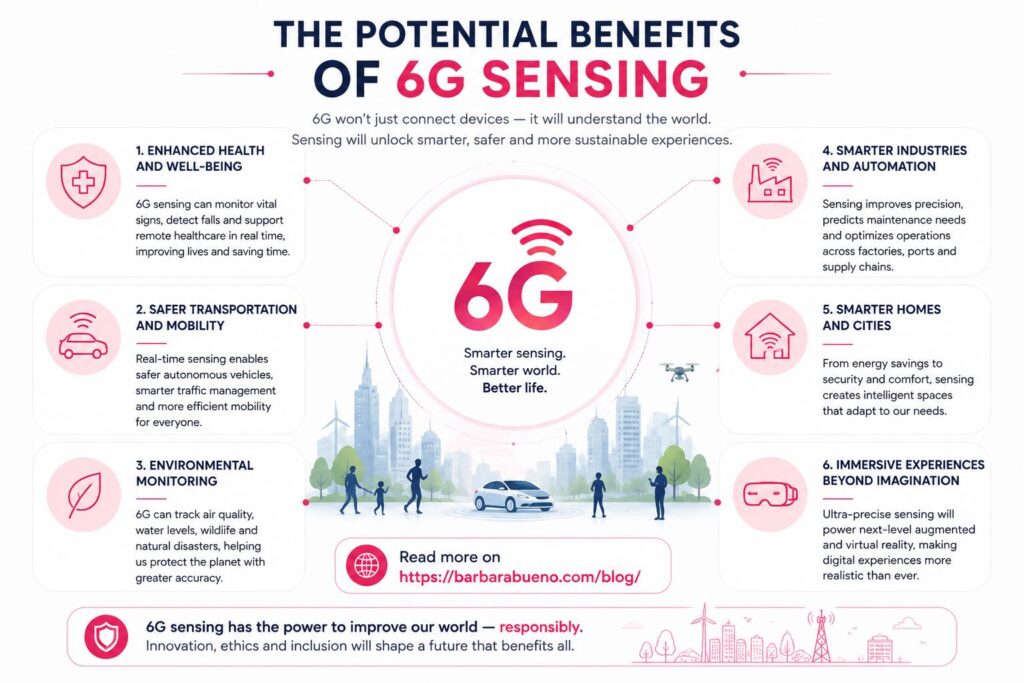
Other potential applications include:
- contactless health monitoring in controlled medical settings;
- fall detection for older adults;
- improved navigation for robots;
- detection of structural changes in buildings;
- monitoring floods or extreme weather;
- more efficient use of energy and network resources;
- better coverage in remote areas;
- coordination between terrestrial and satellite networks.
The challenge is not necessarily to prevent sensing altogether. It is to ensure that useful applications do not create an invisible and permanent system for monitoring individuals.
What happens next?
6G is still being developed. Its final technical specifications, frequencies and commercial applications have not yet been completed.
The ITU expects candidate technologies to be submitted and evaluated as part of the IMT-2030 standardization process. At the European level, research, spectrum planning and experimental projects are already under way, but the first commercial deployments are not expected before approximately 2030.
For Italy, the practical timeline will become clearer only after international standards are completed and European spectrum policies are translated into national decisions.
Until then, statements about exactly what Italian 6G networks will do should be treated as projections rather than confirmed facts.
Should people be concerned about 6G?
There is no reason to panic about a network that has not yet been commercially deployed. There is, however, a strong reason to pay attention while its standards and rules are still being written.
The sensing capabilities under discussion are not science fiction. Radio-frequency systems can already detect forms of presence, movement and physiological activity in controlled conditions.
What remains undecided is how extensively those capabilities will be incorporated into commercial networks, who will be allowed to use them and what protections will apply to people who never consented to being sensed.
The most important debate about 6G may therefore not be how fast it will be. It may be whether societies can benefit from networks that understand the physical world without turning everyday environments into invisible surveillance spaces.