What role did money play in the Middle Ages? Was it as important and essential as it is today? Find out here.
Table of Contents
The Importance of Money in the Middle Ages
With the fall of the Roman Empire, money lost its importance in Europe. In the Middle Ages, there was little need for currency; instead, people relied on barter—exchanging goods directly with one another.
During the medieval period, society was divided into three groups. At the top were the monks and the Church, who fought the devil through prayer. Next came the nobles, who wielded swords to defend the Church. Finally, there were the common people, those who worked to sustain the other two groups.
A medieval farmer, for example, knew that a significant portion of his grain production would go to his feudal lord. He had to reserve some grain for the next planting season, and only if there was any left could he use it to feed his family.
Wealth in the Middle Ages was also perceived differently from today. A rich person was a landowner with many peasants working for him. These peasants brought grain to the castle to make bread and provided animals for the lord’s table. A wealthy medieval individual was not just someone with material riches but someone with power—owning slaves, servants, and quality iron weapons for warfare while enjoying leisure activities like hunting.
The system worked efficiently for centuries. The Church, much like today’s corporations, held significant wealth. Knights were admired and idolized, similar to modern celebrities, traveling the world to fight. Meanwhile, the rest of society simply had to obey.
The End of the Middle Ages
Eventually, things began to change. A new social class emerged—merchants and artisans. These individuals did not fit neatly into the traditional medieval hierarchy. They did not pray, fight, or farm the land. They lived in towns and produced goods that were not always tradable on a large scale.
Consider the artisans who dyed wool red to produce the coveted Venetian fabrics. They could not easily barter with farmers, who spent their days in muddy fields or tending to livestock. This is when an old concept from the Roman era resurfaced—money.
To buy daily necessities such as food, clothing, and housing, medieval merchants and artisans needed currency. While barter was still common, it was not always sufficient. For instance, an Arab spice trader dealing in pepper and cinnamon would likely have little interest in the prized furs of Northern Europe, which were valuable for winter protection but useless in the desert. Instead, precious metal coins became the preferred form of exchange—easy to transport and widely accepted.
Though limited, gold coins were used across vast regions, and some can still be found today in archaeological excavations across Europe.
Charlemagne and Money
With Charlemagne’s rise to power, everything changed. Between 781 and 794, he decreed that the Holy Roman Empire should have a currency worthy of its Roman predecessor. He introduced a new silver coin, reviving an ancient Roman name—denaro (money).
At the time, a pound of silver (approximately 325 grams) was minted into 240 denari. This led to the term lira being used instead of 240 denari. Charlemagne ruled over a vast empire, and by the ninth century, his silver currency effectively became a European-wide monetary standard—a medieval precursor to the euro. In fact, in Northern Europe, it was even more successful than the modern euro, as it crossed the English Channel and was used in southern England. A few years earlier, Offa, King of Mercia, had created a coin with a name that would also prove enduring—the penny.
In Italy, Charlemagne’s currency was used as far south as Tuscany. Beyond that, in Southern Italy, Arab and Byzantine powers controlled the region, and his money had no influence. Rome, positioned between these powers, alternated between using bisanti, mancusi, and denari, depending on the political climate.
Medieval European coins were made exclusively of silver, as bimetallism (using both gold and silver) was considered impractical. In Charlemagne’s Europe, no one even dreamed of minting gold coins.
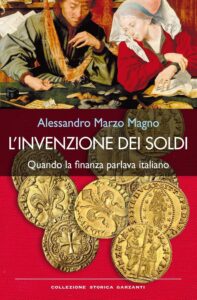
Translated excerpt from the first chapter of the book “L’invenzione dei Soldi – Quando la finanza parlava italiano” by Alessandro Marzo Magno, Collezione Storica Garzanti, 2013.
Read also: Top Podcasts for Book Lovers