A few years ago, I read an article that completely changed the way I think about diamonds.
Table of Contents

Controlled Scarcity
According to the Italian newspaper Il Post, “diamonds are not that rare.” The belief in their rarity is largely due to the commercial strategy of De Beers, which, starting in the 19th century, built a myth that continues to this day.
Diamonds are the most famous and desired gemstones, but not because they are inherently more valuable or brilliant. It all started with the marketing strategies of De Beers, the company synonymous with the entire diamond industry.
De Beers is responsible for the widespread but false belief that diamonds are scarce. While diamond mines are not found everywhere, and the supply of these gemstones is not infinite, the idea that diamonds are rare was intentionally spread.
For decades, De Beers stockpiled large reserves of diamonds, releasing only a portion of the extracted stones. This strategy kept prices high while fueling the myth of diamond scarcity.
The Discovery of Diamonds in South Africa
There was a time when diamonds were indeed rare, and engagement rings of the wealthy were primarily set with rubies and sapphires. Until the late 19th century, diamonds were found only in limited areas of India and Brazil, and the global supply was small.
Things changed about 150 years ago. Around 1870, enormous diamond deposits were discovered in South Africa, making diamonds more common and less expensive.
To prevent prices from falling too much, major investors in the sector decided to unite, founding De Beers Consolidated Mines, Ltd., one of the first diamond mining companies in South Africa.
Among De Beers’ shareholders were the wealthy Rothschild family and Cecil Rhodes, a politician who played a significant role in British colonial expansion.
De Beers was created as a cartel to counter other diamond explorers and aimed to establish a monopoly. Thanks to its vast financial resources, the company was able to buy not only the majority of diamond mines but also many diamonds extracted in other regions. As a result, nearly all mined diamonds passed through De Beers, giving it control over pricing.
Between its foundation in 1888 and the 1990s, De Beers controlled 85% of the world’s rough diamond supply. For decades, the company amassed a massive stockpile of rough diamonds in London. This allowed it to sell fewer diamonds while maintaining high prices by regulating the supply.
While gold, silver, and grain markets fluctuated with economic conditions, diamond prices remained consistently high—with few exceptions.
When demand for diamonds increased, De Beers would release a slightly higher percentage of its stockpile but never in a way that made diamonds seem like an ordinary commodity. When demand decreased—such as during the Great Depression of 1929—De Beers would buy diamonds from sellers and hold them until demand rebounded, ensuring prices remained stable.
Thus, despite becoming a common sight on engagement rings worldwide, diamonds continued to be perceived as rare gemstones.
For a deeper look into this, it is worth reading The Atlantic’s 1982 article “Have You Ever Tried to Sell a Diamond?” by journalist Edward Jay Epstein.
The Concept of the Eternal Diamond
At the same time, De Beers launched a highly successful marketing campaign. Thanks to the work of the American advertising agency N.W. Ayer, consumers worldwide were convinced that proposing marriage required an engagement ring featuring a diamond.
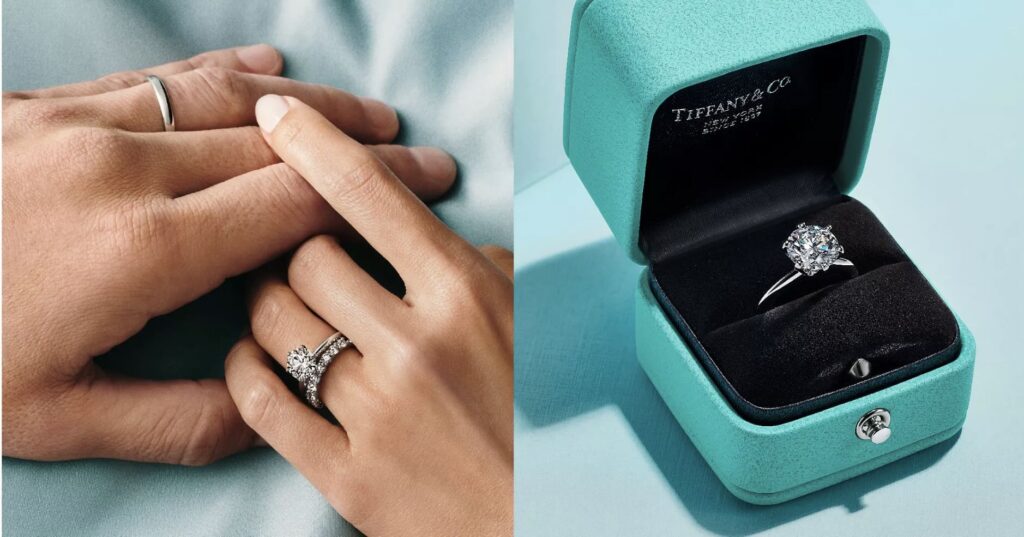
Diamonds became synonymous with rarity, value, and the ultimate symbol of love.
Many young men were led to believe that the size of a diamond reflected the depth of their love—as well as their personal and professional success.
Likewise, many young women were convinced that a diamond was essential proof of their partner’s affection.
“A Diamond Is Forever”
De Beers and N.W. Ayer executed this operation in two key ways. First, they created a highly effective slogan: “A Diamond is Forever.” This phrase, coined by copywriter Frances Gerety in the late 1940s, has been used by De Beers ever since.
But why forever? The slogan served two purposes. First, it linked diamonds to the idea of eternal love, making them more desirable to those receiving them.
Second—and this was the true stroke of genius—it discouraged people from reselling their diamonds. If a diamond is so precious, it should be locked away in a safe and passed down as an heirloom rather than sold. This allowed De Beers to maintain control over the number of diamonds in circulation.
This idea was further reinforced through the entertainment industry. Movie stars were given diamonds so that magazines could report on how certain celebrities had received dazzling stones from their partners.
Below is a video dedicated to Elizabeth Taylor and her iconic diamonds.
N.W. Ayer also pitched stories to magazines and newspapers about famous personalities wearing diamond jewelry, often emphasizing the size of the stones. Diamonds were also placed in Hollywood films—most notably in Gentlemen Prefer Blondes (1953), where Marilyn Monroe famously sang “Diamonds Are a Girl’s Best Friend.”
The marketing strategy worked exceptionally well. In 1939, De Beers sold $23 million worth of diamonds in the United States. By 1979, that number had skyrocketed to $2.1 billion.
Changes in the Diamond Market Since the 1990s
In the 1990s, De Beers faced a shifting global landscape.
With the fall of the Soviet Union, Siberian diamond producers began exporting independently, while new satellite technology helped identify additional diamond sources. Countries like Australia also opted to sell diamonds without De Beers’ involvement.
Facing increasing scrutiny, antitrust authorities forced De Beers to abandon its monopoly. By 2000, the company ceased stockpiling rough diamonds to regain access to the U.S. market, and today, it controls only about one-third of the diamond industry. Meanwhile, developing countries, such as Botswana, have taken a larger stake in the business.
By 2024, the diamond market encountered major difficulties due to high inventory levels and slowing consumer demand, especially in China. While early signs of recovery appeared, continued economic challenges led to declining sales, and U.S. retailers remained cautious.
Additionally, the increasing presence of lab-grown diamonds further disrupted the market, with wholesale and retail prices plummeting.
In response, De Beers reduced rough diamond production by 22% in 2024 and introduced its “Origins” strategy to reinforce the value of natural diamonds while streamlining operations.
We do not know the exact number of diamonds present on Earth, but they are certainly not among the rarest gemstones—rubies, sapphires, and emeralds are actually much scarcer than diamonds.
In fact, research suggests that diamonds may be one of the most common gemstones in nature—not just on Earth but possibly even in space. Some believe they could be found in celestial bodies such as BPM 37093, a white dwarf star in the Centaurus constellation located 50 light-years from Earth.
If you found this article insightful, consider sharing it with others who might appreciate it. We’d love to hear your thoughts—leave a comment and join the conversation! Do you still dream of a diamond ring, or would you rather plan a romantic escape to Tuscany?
Read also: Breaking Records: Italy’s Passenger Air Travel Soars in 2024